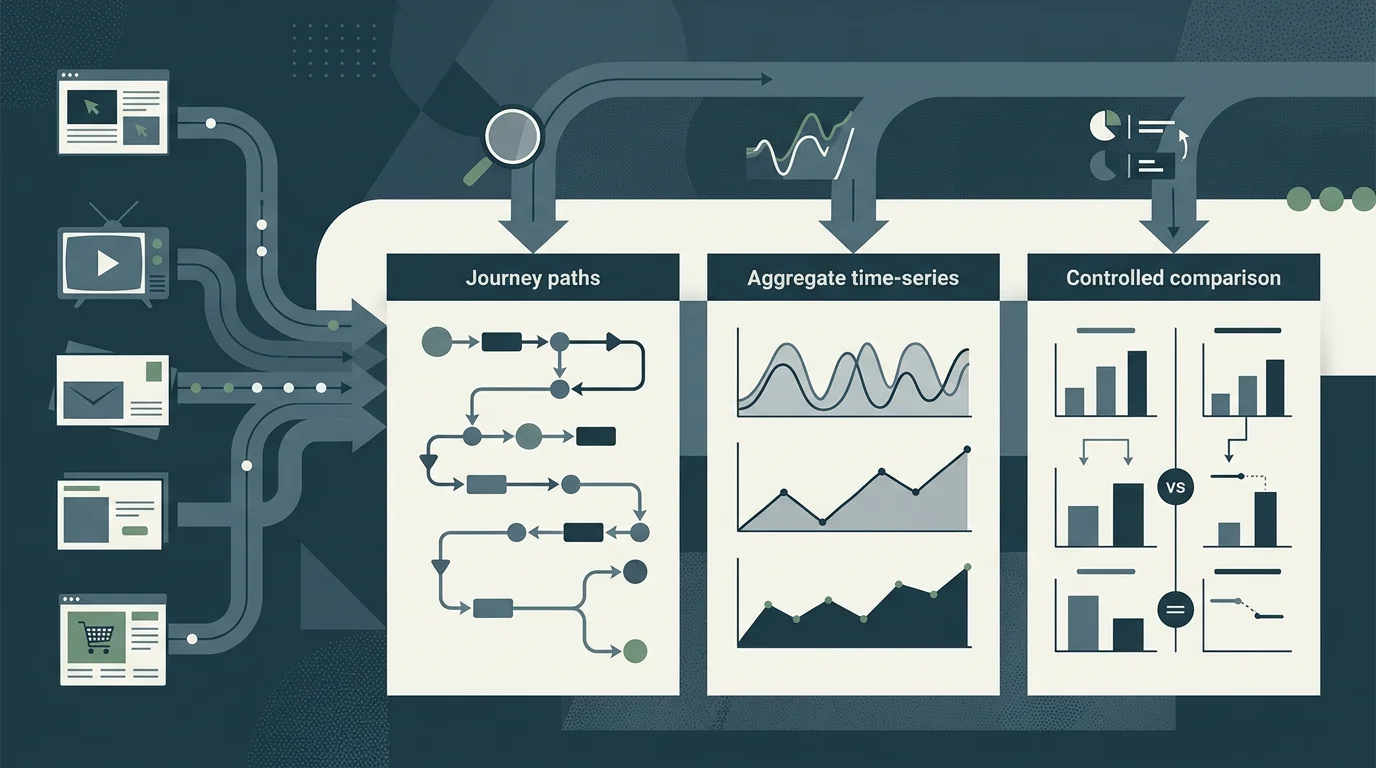

The best Wicked Reports alternatives depend on the decision you need to make. Are you choosing which campaigns deserve more budget, measuring how acquired customers spend over time, or connecting a sales-assisted journey to closed revenue? Those are different jobs—and replacing one reporting tool with another only helps when the new tool addresses the right job.
Wicked Reports focuses on first-party, click-based attribution for ecommerce and subscription businesses. Its strengths include order attribution, new-versus-repeat customer reporting, and cohort and lifetime value (LTV) reports. Start by identifying which of those capabilities you use, then compare alternatives against your business model, reporting needs, and budget.
What is Wicked Reports?
Wicked Reports is an attribution platform for ecommerce and subscription businesses. It connects orders to the clicks that drove them and separates new customers from repeat buyers down to campaign and creative. That distinction matters when you want to understand acquisition performance rather than treat every purchase as a newly acquired customer.
Its reporting also extends beyond the initial order. Cohort and LTV reports help teams examine customer value over time, while lifetime lookback and lookforward support analysis of longer journeys. These are part of its documented offering, not capabilities to remove from the comparison when discussing alternatives.
How does this work?
Wicked Reports uses first-party, click-based attribution to connect marketing activity with order revenue. Its plans include major ad-platform, cart, and standard CRM integrations. The platform also sends a verified new-customer event to ad platforms so campaigns can optimize toward new buyers rather than repeat purchases.
The practical buyer question is what you want to do with that connection. Campaign attribution helps allocate marketing spend. Customer classification helps distinguish acquisition from repeat business. Cohort and LTV analysis help explain what customers are worth after acquisition. A replacement should be evaluated against each requirement separately.
What kinds of reports does Wicked Reports provide?
- Order and campaign attribution: connect revenue to the clicks that drove purchases.
- New-versus-repeat customer reporting: distinguish customer acquisition from repeat purchases at campaign and creative level.
- Cohort and LTV reports: examine customer groups and lifetime value.
- FunnelVision prebuilt views: use predefined views included in the Measure plan.
Attribution answers which marketing activity gets credit. Cohort analysis compares customer groups over time. LTV measures customer value across a relationship. A broader analytics dashboard is not automatically a substitute for all three.
For a closer look at the distinction, read our guides to marketing attribution and calculating LTV.
What does Wicked Reports cost?
Wicked Reports pricing is aligned to trailing 12-month gross revenue. Its published tiers are:
| Plan | Monthly price | Key scope |
|---|---|---|
| Measure | $499 | $0–$2.5 million annual revenue; cohort and LTV reports, FunnelVision, lifetime lookback/lookforward, and standard integrations |
| Scale | $699 | Adds CRM/cart APIs, outbound API, currency conversion, and international time-zone loading |
| Maximize | $999 | Adds 5 Forces AI, Advanced Signal for Meta CAPI, custom conversions, and Amazon revenue integration |
| Enterprise | From $4,999 | For $50 million-plus brands; includes implementation, priority support, and enterprise options |
Plan changes apply at the next renewal after a revenue band is crossed. Wicked Reports also advertises a 3x guarantee: if logged decisions do not reach three times the subscription within 90 days, the service is free until that threshold is reached. That guarantee is distinct from a free trial.
Is using Wicked Reports a game-changer?
Its value depends on whether its reporting changes decisions that matter to your business. The $499/month entry plan deserves consideration when order attribution, new-customer measurement, and cohort/LTV analysis are recurring operational needs. If your immediate problem is simply understanding which channels and campaigns deserve more spend, focus the comparison on that narrower job.
For larger businesses, the decision may move in the opposite direction: beyond historical attribution toward forecasting, offline measurement, or media mix modeling. More reporting is useful only when it supports a decision your team can act on.
Best Wicked Reports alternatives: compare by fit
The comparison below separates attribution needs from adjacent buying decisions. Keep channel attribution, lifetime-revenue analysis, campaign execution, and consolidated analytics as distinct requirements rather than assuming every name on an alternatives list is interchangeable.
1. Weberlo
Best for: teams that want understandable channel and campaign attribution to support budget decisions.
Weberlo belongs on your shortlist when the central question is, “Which marketing activity should receive more budget?” Keep the evaluation focused on making channel and campaign performance understandable enough to guide allocation, rather than buying a wider analytics suite for its own sake.
Key comparison points
- Start with the channels and campaigns you need to compare.
- Define the budget decisions those reports should support.
- Keep attribution requirements separate from customer-value and retention requirements.
Tradeoff: position Weberlo as an option for channel/campaign attribution, not as a replacement for dedicated cohort, LTV, or retention analysis. If those functions drive your reporting process, retain them as separate requirements in your measurement stack.
Pricing: see Weberlo pricing. Explore the ad tracking and attribution models pages to frame your comparison.
2. Hyros
Buyer job: comparing another candidate against your attribution requirements.
Key comparison points
Separate the need to credit campaigns for conversions from the need to calculate customer value over time. Write down your required revenue events, attribution views, and reporting time horizons. A conversion report and a cohort report serve different purposes, even when both appear in an attribution buying discussion.
Fit boundary: an alternative should earn its place through the reporting job it addresses—not promised sales lifts or reductions in ad costs. Our Hyros review provides a separate comparison route.
3. SegMetrics
Best for: businesses with lead funnels, customer segmentation needs, and longer customer journeys.
Key comparison points
SegMetrics focuses on funnel and lifetime-revenue attribution, including touchpoint analysis and segmentation. It is a relevant comparison when a lead becomes a customer later and you want to understand revenue across that longer relationship.
Tradeoff: prioritize it around the lead-to-customer journey and lifetime revenue, rather than treating it as the same buying decision as a broader ecommerce operating dashboard. Lifetime-revenue analysis is also not the same requirement as product engagement or retention reporting. See our SegMetrics alternatives guide for related options.
4. ActiveCampaign
Buyer job: keeping campaign execution and attribution measurement separate in the buying process.
Key comparison points
ActiveCampaign appears among Wicked Reports competitors in software comparison lists. That inclusion should not collapse two separate requirements: running marketing activity and measuring which activity receives revenue credit.
Fit boundary: define the measurement outcome first. A need to change campaign execution does not, by itself, resolve a need for order attribution, new-customer reporting, or cohort/LTV analysis.
5. SharpSpring
Buyer job: distinguishing lead-process needs from attribution needs.
Key comparison points
For a sales-assisted business, distinguish lead creation, pipeline progression, and closed revenue. Those milestones need different reporting definitions. A useful attribution comparison connects the marketing decision to the milestone that actually matters to your team.
Fit boundary: keep lead workflow requirements on one side of the scorecard and revenue measurement on the other. Neither should stand in for the other.
6. impact.com
Buyer job: defining how partner-related activity fits into the wider revenue measurement requirement.
Key comparison points
impact.com also appears in software alternatives lists alongside Wicked Reports. For a comparison involving partner-driven revenue, separate the credit assigned to an individual partner from the contribution of channels across the full journey.
Fit boundary: partner-level reporting and cross-channel budget allocation are distinct jobs. Decide which one you are replacing before comparing the tools.
7. Pardot
Buyer job: defining measurement for a CRM-led buying journey.
Key comparison points
A B2B scorecard should distinguish contacts, accounts, opportunities, and won deals. A checkout-based comparison does not capture those requirements. Our B2B marketing attribution guide explains this measurement context.
Fit boundary: when closed-won revenue is the primary outcome, use a B2B revenue-attribution shortlist rather than choosing solely from ecommerce attribution software.
8. Datorama
Buyer job: distinguishing consolidated reporting from attribution.
Key comparison points
Putting channel metrics in one place and assigning revenue credit across touchpoints are separate tasks. In a broader analytics comparison, define whether the required output is a consolidated KPI report, an attribution view, or a planning model.
Fit boundary: dashboard breadth alone should not determine a Wicked Reports replacement. The deciding factor is whether the reporting supports the revenue question you need to answer.
9. Act-On
Buyer job: separating marketing activity and engagement from revenue outcomes.
Key comparison points
Engagement, lead progression, and revenue each describe a different stage of performance. Keep those definitions explicit when considering changes to your marketing stack.
Fit boundary: an engagement reporting requirement is not a substitute for campaign revenue attribution. Set the revenue outcome before deciding which category of tool belongs on the shortlist.
10. Improvado
Buyer job: separating data preparation from attribution analysis.
Key comparison points
A reporting project can involve bringing data together, standardizing definitions, presenting dashboards, and assigning attribution credit. List those as separate tasks. This makes it easier to distinguish a wider data project from a focused replacement for campaign measurement.
Fit boundary: choose the scope your team actually needs. More data infrastructure is a different investment from clearer day-to-day attribution.